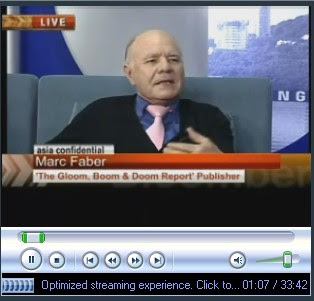
Marc Faber chats with Bloomberg

Marc Faber sits down with Bloomberg TV for an extended chat about the global economy and investment markets.

Faber tells Bloomberg's Bernard Lo that the global economy is "stuffed" for some time, with economic activity (ex-government spending) is down about 15 percent from the peak (2006-2007).

This past prosperity was built on borrowed money, and although Marc expects the economy to stabilize at some point, he does not expect us to surpass these peaks in prosperity and speculation for some time.

However, Marc does see intriguing value in depressed commodities and equities in sound companies. Whenever the recovery comes, it should lift these asset prices.

Marc is also still long-term bullish on gold and all the precious metals, given the unprecedented state of global money printing and the inflation that is sure to follow.

Plenty more to hear in this engaging and entertaining interview clip; be sure to catch Marc's comments on some of the "special" crops that grow near his farm in Thailand!

Related articles and posts:

1. Marc Faber thinks markets could rally - Finance Trends.

2. Jim Rogers: US bailouts add to depression risk - Finance Trends.

Popular posts from this blog

Finance Trends 2019 Mid-Year Markets Review

Email subscribers of the Finance Trends Newsletter receive the first look at new articles and market updates, such as the following piece, sent out to our email list on Sunday (6/14).   Hello and welcome, everyone! If you received our last email notice over the July 4th holiday, you'll know that this weekend's newsletter will serve as a mid-year market update and a follow-up to issue #29, " How to Reinvest in a Rising Market ".   Ladies and gentlemen, without further ado, let's start the show...  Finance Trends Newsletter: Our Mid-Year Market Review When we last spoke, back in February, the U.S. stock market was rallying off its December-January lows. As the S&P 500 and Nasdaq reclaimed their 200 day moving averages in February and March, it became increasingly apparent that a lot of retail investors (and perhaps some institutional investors) were left under-invested while watching this recovery move from the sidelines.  The U.S. stock ...

Jesse Livermore: How to Trade in Stocks (1940 Ed. E-book)

If you've been around markets for any length of time, you've probably heard of 20th century supertrader, Jesse Livermore . Today we're highlighting his rare 1940 work, How to Trade in Stocks (ebook, pdf). But first, a brief overview of Livermore's life and trading career (bio from Jesse Livermore's Wikipedia entry). "During his lifetime, Livermore gained and lost several multi-million dollar fortunes. Most notably, he was worth $3 million and $100 million after the 1907 and 1929 market crashes, respectively. He subsequently lost both fortunes. Apart from his success as a securities speculator, Livermore left traders a working philosophy for trading securities that emphasizes increasing the size of one's position as it goes in the right direction and cutting losses quickly. Ironically, Livermore sometimes did not follow his rules strictly. He claimed that lack of adherence to his own rules was the main reason for his losses after making his 1907 and...

How to "Pull the Trigger" on Your Trading Ideas

In our last post, I quoted hedge fund manager, Jim Leitner on the importance of following up on your investment ideas.  Today I'd like to follow up and share some thoughts on how you can learn to consistently "pull the trigger" on your best trading setups and investing ideas. In order to help you do that, we'll take from the best and offer up key insights from interviews with top traders and trading psychologists like Alan Farley, Brett Steenbarger, and Doug Hirschhorn .  Now before we get to their key insights on overcoming trading anxiety and pulling the trigger on your trading ideas, let's remember what Jim Leitner said in his interview: "Learn to love to listen to people and when you hear something interesting, follow up on it. Don't just think, "Well that's an interesting idea" only to find out a year later that the company you could've bought shares in is now up 500-fold. You never want to say woulda, coulda, shoulda...