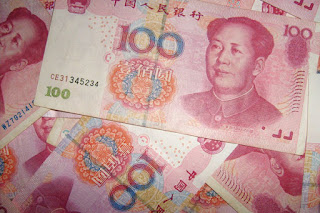
What a renminbi revaluation means for commodities, economy


As I don't pretend to be an expert on matters of currency movements, here are comments from a few more knowledgeable sources on the recent policy shift in the Chinese renminbi (yuan) currency peg.

1. China to put renminbi in a currency basket - Daily Reckoning. "The renminbi is now 'flexible!'" These cats reckon that moves higher in the RMB vs. the dollar are not a foregone conclusion (as many/most suspect).

2. Chinese yuan under 5 by 2020 - Maoxian. Chairman Maoxian sees a long-term controlled appreciation of the Chinese currency that is likely to suit the country's own interests (and timetable).

3. Yuan revaluation impact to be limited - PragCap. Bondsquawk contributes this post on the revaluation, noting that deterioration in the euro is having an effect on "China's plan of allowing considerable appreciation for the yuan".

4. Chinese currency: why Americans should care about yuan revaluation - CSMonitor. Notes on how the exchange rate flexibility announcement could affect Chinese export prices and prices of US exports into China.

On a related theme, Wall Street Journal notes that anticipation of a stronger RMB has "sparked hopes of increased Chinese demand for commodities". As noted in the WSJ piece, some of the basic materials and metals mining stocks are getting a boost today on the revaluation.

While traders are taking the yuan revaluation news as a sign of strength for resources and the global economy, we wonder if investors like Felix Zulauf would agree with this one day verdict.

Zulauf and Marc Faber were both recently quoted in Barron's mid-year Roundtable as saying they expected a downturn for commodity prices, along with a slowdown (or "tightening") in China and the resource economies (Australia & Brazil) tied to its economic prospects.

Will the yuan revaluation turn out to be more of a strategic move which favors China rather than its economic rivals and resource suppliers?

Popular posts from this blog

Lessons from Hedge Fund Market Wizards: Scott Ramsey

Today we continue our series, "Lessons from Hedge Fund Market Wizards" , with a look at Jack Schwager's interview with Scott Ramsey of Denali Asset Management.  Ramsey, a futures trader and CTA who works on the island of St. Croix, spoke to Schwager about his first foray into the markets, his evolution as a trader, and the process he stands by to protect and grow his clients' money. 1) . Ramsey started trading in college. He was roped into the OTC metals market via a broker's ad in the Wall St. Journal. The broker charged customers a flat fee to buy and sell as much as they wanted in a particular market for six month. At the time, Scott was a novice and didn't know about futures, so he traded metals in this fashion through the inflationary run-up of the late 1970s. 2) . Scott had to rethink his trading strategy after he bought silver at $50 an oz., only to watch it collapse to $26 following a long string of limit-down days. He sold as soon as the market...

How to "Pull the Trigger" on Your Trading Ideas

In our last post, I quoted hedge fund manager, Jim Leitner on the importance of following up on your investment ideas.  Today I'd like to follow up and share some thoughts on how you can learn to consistently "pull the trigger" on your best trading setups and investing ideas. In order to help you do that, we'll take from the best and offer up key insights from interviews with top traders and trading psychologists like Alan Farley, Brett Steenbarger, and Doug Hirschhorn .  Now before we get to their key insights on overcoming trading anxiety and pulling the trigger on your trading ideas, let's remember what Jim Leitner said in his interview: "Learn to love to listen to people and when you hear something interesting, follow up on it. Don't just think, "Well that's an interesting idea" only to find out a year later that the company you could've bought shares in is now up 500-fold. You never want to say woulda, coulda, shoulda...

Moneyball: How the Red Sox Win Championships

Welcome, readers . T o get the first look at brand new posts (like the following piece) and to receive our exclusive email list updates, please subscribe to the Finance Trends Newsletter .   The Boston Red Sox won their fourth World Series title of t he 21st century this we ek. Having won their first Se ries in 86 years back in 200 4, the last decade-plus has marked a very strong return to form for one of baseball's oldest big league clubs. So how did they do it? Quick background: in late 2002, team own er and hedge fund manager, John W. Henry (with his partners ) bought the Boston Red Sox and its historic Fenway Park for a reported sum of $ 695 million. Henry and Co. quickly set out to find their ideal General Manager (GM) to help turn around their newly acquired, ailing ship. This brings us to one of my fav orite scenes from the 2011 film , Moneyball , in which John W. Henry (played by Ar liss Howard) attempts to woo Oakland A's GM Billy Beane (Brad Pi...